August 30, 2026
Why there is no serious African dress curriculum in Nigeria and what we built instead
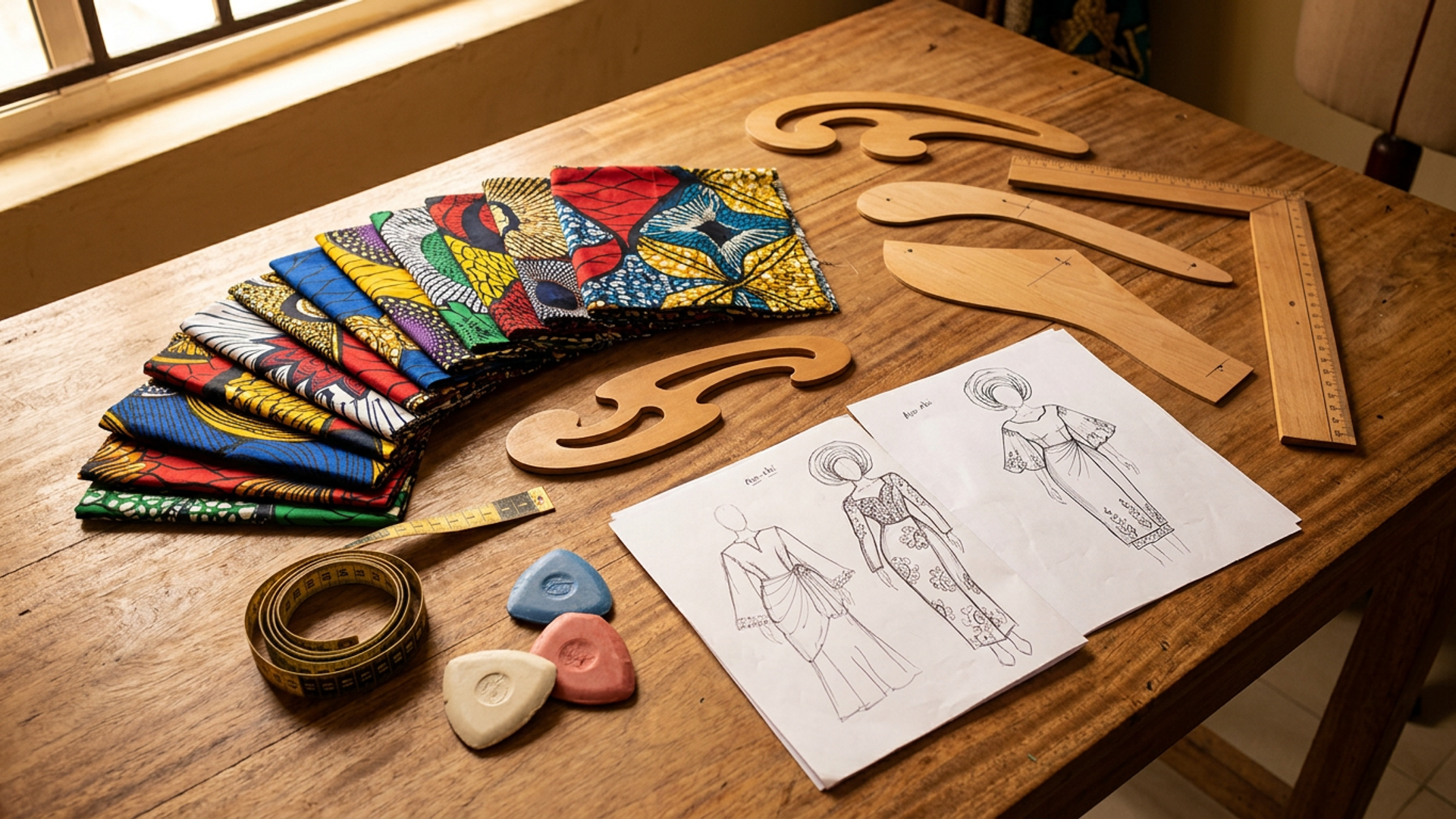
Nigerian fashion schools have been teaching European pattern systems for decades. The textbooks are British. The block patterns assume Western measurements. The fabric behaviour in every module is woven polyester or cotton poplin, not Ankara with its stiff fused structure, not Adire with its hand-resist texture, not Aso-oke with its dimensional weave.
There is almost no formal curriculum, anywhere in Nigeria, for how to construct a wrapped Ankara dress, a structured Adire shift, or an Aso-oke evening top from a brief.
How fashion education ended up this way
Nigerian fashion training followed the colonial trade school model. The frameworks arrived with institutional weight: NBTE registration, certificate structures, textbooks with publishers behind them. They were built for an industry in Britain and transplanted wholesale.
African dress construction was practised, not taught formally. Knowledge moved from senior seamstress to apprentice, mother to daughter. That is a legitimate transmission channel, and it produces real craft. What it does not produce is design literacy: the ability to draft a new silhouette from a brief, adjust fit for a non-standard body, or document a construction process another maker can follow.
The gap between what Nigerian fashion schools teach and what constructing African dress actually requires has been wide for a long time. Nobody gave it a curriculum.
What Western bias looks like in practice
A student in a standard Nigerian fashion course learns to draft a bodice block sized to European measurements. She learns seam allowances calibrated to woven broadcloth. She learns a fitting adjustment vocabulary that assumes stretch fabrics work one way and wovens another, which is accurate for denim and jersey and incomplete for a stiff Ankara that holds a curve differently than any European equivalent.
None of this is the teacher's failure. The syllabus was written for a different industry.
What we built at NFD Academy
NFD Academy runs two physical branches in Nigeria. We built a curriculum for those branches before we built anything online. We know what structured African garment training looks like because we tested it with real students, in a real studio, on real fabric.
The online curriculum is not a collection of techniques assembled from what seemed useful. It is a sequence. And the sequence is the point.
The African Fashion Foundation course comes first. It covers fabric identification for Ankara, Adire, and Aso-oke: how each behaves, what construction decisions each demands, why they cannot be taught with the same block patterns. It covers cultural context and construction vocabulary. A student who skips this step can copy a garment she has seen. She cannot design one.
Dress Design Essentials follows with the practical construction module: pattern drafting, cutting, fitting, garment finishing. Each step builds on the last. There are no gaps in the syllabus because we identified the gaps in existing curricula and closed them.
Every instructor is a practising designer, currently working in the field. That is a structural choice, not a credential claim. Fitting adjustments for real African fabrics on real bodies require current practice, not archived knowledge.
Where to start
The African Fashion Foundation course is free to enter. One complete lesson, no payment required. If the teaching works for you, the construction module continues from there.
Both courses are online, self-paced, and taught by NFD branch designers. There is no campus, no relocation, no high tuition gate.
The curriculum exists. It is Africa-first, sequenced, and built for this.